
If you are evaluating URL redirect services, urllo and RedirHub will likely both come up. Both are managed, hosted platforms: you point a domain at them, they provision SSL, deliver redirects from a global edge network and give you analytics, an API and team controls.
Redirect services being able to redirect a URL over HTTPS is standard; that’s why other factors such as track record, what compliance each can prove and performance matter so much.
A little background. urllo, previously EasyRedir, has managed redirects since 2014. More than 1,000 companies such as Liquid Death, Porsche and Skullcandy, across 75+ countries rely on it, from small teams through to enterprises and urllo handles over 25 billion requests a year across a network of 130+ points of presence.
RedirHub is a managed URL redirect and link platform, founded in 2019, with a global edge network, automatic HTTPS, analytics, an API and a permanent free tier. It positions itself as a fast, modern replacement for registrar forwarding and self-hosted redirect servers, with a broad feature set aimed at everyone from personal projects to enterprises.
What to look for in a redirect service
Start with one question: what happens to the business if a redirect quietly fails? Low-traffic links allow more risk. Redirects supporting revenue, migrations or customer access do not. As the stakes rise, evaluate providers on track record, delivery model, supported use cases, compliance and reliability.
Track record and proven scale
When redirects support revenue or customer access, the provider becomes a long-term infrastructure decision. Look for a proven operating history, enough points of presence for redundancy and protection against traffic spikes and DDoS attacks. Newer providers may be capable, but a limited track record gives you less evidence of how they perform at scale or over time.
Delivery model and use case
Before comparing tools, get specific about two things: what kind of redirect you actually need and who runs the infrastructure behind it. "Redirect" covers several distinct jobs:
- A page-level redirect moves one URL to another within the same site, say exampledomain.com/guide/2025 to exampledomain.com/guide/2026.
- A cross-domain redirect routes a particular URL to a different property, such as oldsite.com/pricing to newsite.com/plans.
- A domain redirect passes an entire domain to another, sending oldbrand.com through to newbrand.com.
That targeted, same-site routing is trickier than forwarding a whole domain and it calls for control at the edge, rather than at DNS alone.
That is where the delivery model comes in and it's the choice easiest to overlook.
Some providers host the whole thing: you repoint DNS or wire in at the edge and they operate everything from there.
Others integrate with your edge, allowing more control over your redirects and website.
Some URL redirect services offer both DNS and edge integrations to offer both types of redirects to fit your situation.
The right pick comes down to which trade-off suits your team, your compliance obligations and the kind of redirect jobs above that you actually need to run.
Compliance and governance
When multiple people can change redirects, governance becomes a security requirement. A mistaken or malicious rule can reroute campaigns, disrupt customer access or damage SEO.
What to look for splits into two parts. The first is governance: the controls that decide who can do what and leave a trail when they do.
- Role-based access, so marketing or SEO can make changes without holding keys to everything.
- Single sign-on and two-factor authentication, so access ties to your identity provider and not a shared password.
- Audit logs that record what changed, when and by whom become essential the moment a redirect touches SEO, revenue or customer access.
- Encryption of your data in transit and at rest.
The second is evidence. Controls on a features page are a claim; an independent attestation is proof. Depending on your organization and where your users are, you may need a provider that can produce specific documentation:
- A SOC 2 Type 2 report, the attestation most security and procurement teams ask for before a vendor is allowed near production systems.
- Data residency in the regions you operate, so records stay within the jurisdictions your policies require.
- Alignment with regulations that apply to you, such as GDPR.
These controls may be unnecessary for a personal domain. For customer-facing infrastructure, however, independently verified security can determine whether procurement approves the service at all.
Reliability and performance
A redirect is a single link in the chain between the click and the page. If it's slow, the destination feels slow before it has a chance to load. If it's down, the destination can be perfectly healthy and the visitor never arrives. That is what makes reliability and performance less like features to tick off and more like the thing you are actually paying a redirect service to guarantee.
For a hobby domain, an occasional hiccup is survivable. For a campaign in motion or a domain your brand rests on, it is not. A redirect that fails during a paid campaign wastes every dollar that drove the click. Added delay on a high-intent link can have a strong negative impact, with bounce rate increasing by 32% when the page load speed goes from 1s to 3s. One that stalls in front of a login or checkout reads to the visitor as your brand being broken, not the redirect. One that fails partway through a migration sends search engines conflicting signals and pulls rankings down exactly when you need them to hold.
What's the difference between urllo and RedirHub?
The verifiable differences come down to track record and proven scale, how redirects are delivered, what compliance each can prove and how reliably and fast each performs.
1. Track record and proven scale
A redirect service holds your domains and URLs. If it goes offline, so do they and if the company behind it disappears, your redirects go with it. That makes this less a question of features than of trust: how much evidence is there that this provider will keep your URLs live, this year and years from now?
Companies need revenue to survive. If a company doesn’t make enough revenue, it goes out of business. If the company that manages your domains and redirects goes bankrupt, where does that leave your domains?
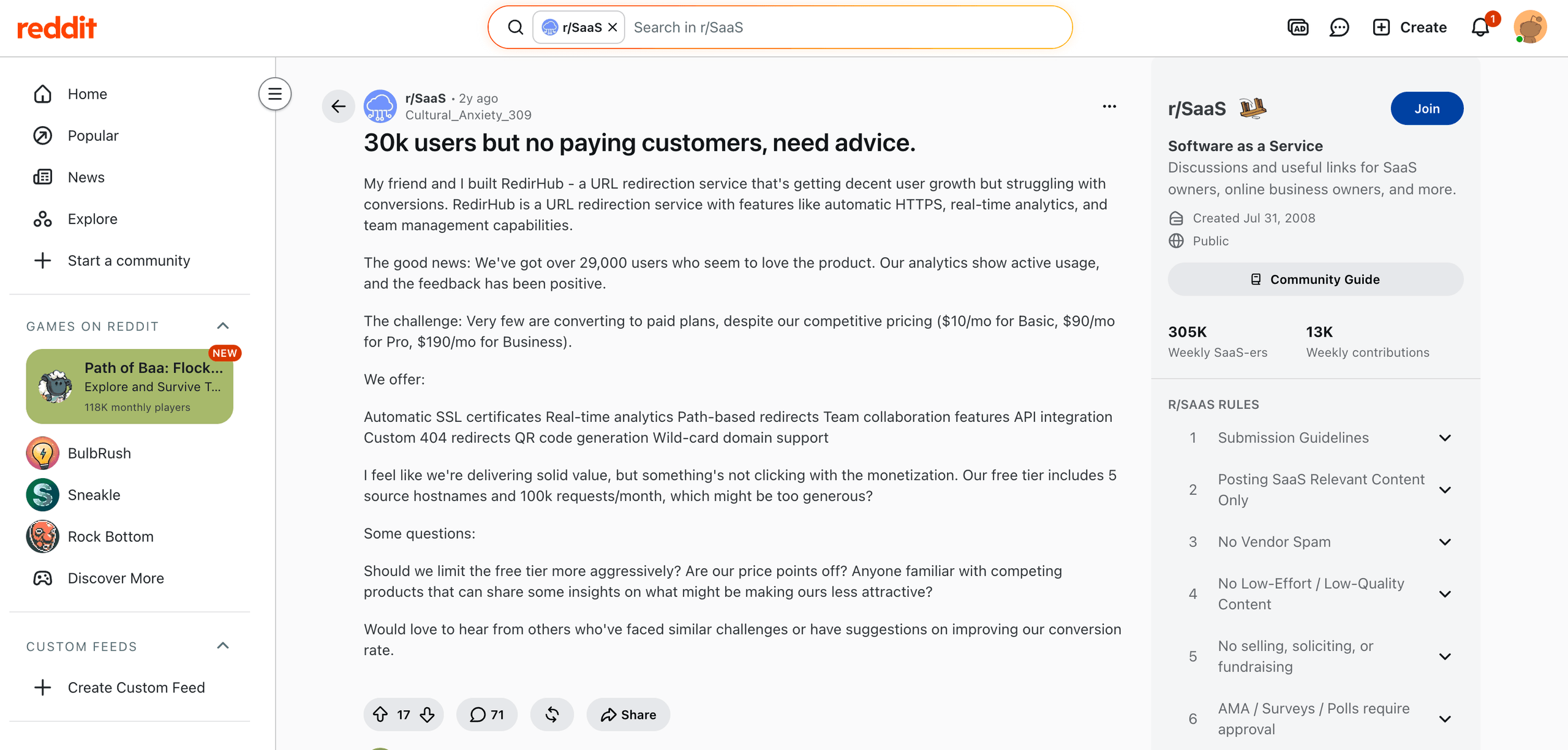
RedirHub has described having roughly 30,000 users but almost no paying customers on a Reddit thread from two years ago. While this is from two years ago and may not be the case now, it can be concerning to know that the URL redirect service managing your domains could be one bad month, quarter or year away from disappearing.

There’s a reason social proof is so effective as a trust signal. People look to other people who have already made the decision to help them decide. If you see a large number of people waiting in line at a restaurant, there’s a good chance the food and service are good. The same applies to companies. If The Cheesecake Factory, UNICEF and Crunchyroll trust urllo to keep their domains online, chances are you can count on them to keep your domains online and redirecting.
Unlike newer alternatives such as RedirHub, urllo has managed redirects for more than a decade. That proven experience is why leading global companies trust urllo with business-critical redirect infrastructure.
2. Delivery model and use case
Both deliver redirects from the edge after you point a domain at them through DNS. Where they differ is in selective, same-site routing: redirecting specific URLs while the rest of a site keeps serving from its origin.
urllo offers an edge integration alongside its hosted DNS option, so you can redirect particular URLs while every other request continues to load from your origin, without forwarding the whole domain. RedirHub follows a hosted forwarding model where the hostname is pointed at RedirHub and redirect rules, including path-based rules, are handled there. If you need some paths redirected while the domain stays live for everything else, you will need an edge-integrated setup.
3. Compliance and governance
Both platforms have security features and both offer role-based access, audit logs, two-factor authentication, encryption in transit and at rest and SSO. The difference is what each can evidence and prove.
urllo publishes a SOC 2 Type 2 attestation, a report many security and procurement teams ask for before a redirect service is allowed near production domains. RedirHub documents a strong set of controls and stores data in both the US and EU, but that is not the same as data residency. Residency means you choose where your data lives, and RedirHub does not appear to offer that choice. It also does not appear to publish a SOC 2 Type 2 attestation. If your procurement process gates on that specific report, it is worth confirming directly with each vendor.
4. Reliability and performance
RedirHub positions itself as the fastest, most reliable URL redirect service on the market. RedirHub publishes figures from its own uptime monitor, which the public (including us) can’t verify. So instead of taking these numbers as fact, when they could be manipulated, consider other factors. For example, guarantees they make, customer reviews, the brands that choose to use their services and any other third-party data (be careful of sock puppets).
Both platforms are purpose-built and make strong performance and reliability claims. RedirHub runs a global edge network and markets fast delivery, with routing to the nearest location and a 100% uptime SLA on its enterprise plan.
urllo also offers a 100% uptime SLA on enterprise and backs it with a published 99.999% historical uptime record and a larger delivery network of 130+ points of presence, against RedirHub's smaller published footprint. More points of presence mean a shorter trip to the nearest edge, which is where consistent performance comes from as traffic spreads across regions.
Truthfully, both platforms serve redirects quickly and stay up under normal conditions. The differences worth weighing are the length of the track record behind the reliability claim and the breadth of the network delivering it, both of which matter more the more geographically spread and business-critical your traffic becomes.
| Feature | urllo | RedirHub |
|---|---|---|
| Free plan | ✖ | ✔ |
| Free trial | ✔ (14-day) | ✔ (14-day) |
| Automatic SSL/TLS | ✔ | ✔ |
| Path and query forwarding | ✔ | ✔ |
| QR codes and branded links | ✔ | ✔ |
| API | ✔ | ✔ |
| Bulk import/export | ✔ | ✔ |
| Team roles, audit logs and 2FA | ✔ | ✔ |
| SSO | ✔ (add-on) | ✔ (add-on) |
| Detailed analytics with approximately 12 months of history | ✔ | ✔ |
| Unlimited traffic with no request metering | ✔ | ✖ (metered by tier) |
| Destination health monitoring | ✖ | ✔ |
| Edge integration and origin-preserving redirects | ✔ | ✖ |
| SOC 2 Type 2 attestation | ✔ | ✖ (not published) |
| Global edge network | ✔ (130+ POPs) | Not listed |
| 100% uptime SLA | ✔ (enterprise) | ✔ (enterprise) |
| Operating since | 2014 | 2019 |
So, who should you choose?
Both URL redirect services are close enough that the right answer comes down to priorities more than any single feature.
Choose RedirHub if you want a permanent free tier to start or if its particular feature set fits your work: multiple-destination A/B routing, destination health monitoring or custom HTML responses. Its request-metered pricing suits teams whose traffic is predictable and who would rather pay in tiers. They also offer iframe and masked redirects, while urllo doesn’t offer either due to the negative impact on SEO and user experience.
Choose urllo if redirects are business-critical infrastructure and you value a long, proven operating record, unlimited traffic on every plan so a spike never changes the bill, a published SOC 2 Type 2 attestation for procurement, a 130+ point global network and edge integration that redirects specific URLs while your origin keeps serving the rest.
One factor that doesn't show up on a feature list: the team behind the service. A redirect service is only as dependable as the people keeping it running and there is a real gap here.
On LinkedIn, urllo lists nine employees, with 1045 followers; RedirHub lists one named employee, with 88 people following it. For a hobby domain, a small operation is fine. For redirects your revenue depends on, a team means coverage; if one person is asleep, on holiday or unwell when something breaks, someone else can still answer the ticket, ship the fix or respond to the incident. urllo also has a dedicated customer success team to help you pick the right plan, onboard your redirects and support you afterward.
A closing note on research. RedirHub appears to operate at least two seemingly independent sites that review and monitor redirect services and consistently rank RedirHub first. It's worth checking who owns the "neutral" comparisons and monitors you come across in this category and weighing any single source, this one included, accordingly.
Still not sure which is right for your needs? Our team can talk through your setup and help you figure out which of these differences actually matters for you.
Frequently asked questions about urllo vs RedirHub
What's the main difference between urllo and RedirHub?
They are similar managed, hosted redirect platforms with heavily overlapping features. The practical differences are urllo's longer operating record and larger published scale, its unlimited traffic on every plan versus RedirHub's request-metered tiers, its published SOC 2 Type 2 attestation and its edge integration for origin-preserving redirects. RedirHub counters with a permanent free tier and features like multiple-destination routing and destination monitoring.
Is urllo a RedirHub alternative?
Yes. urllo works as a RedirHub alternative, especially for teams that need unmetered traffic, a SOC 2 Type 2 attestation, a longer proven track record or edge integration that keeps the origin serving unmatched paths. If your priority is a free-forever plan or features like A/B routing and destination monitoring, RedirHub may suit those workflows better.
Do both meter traffic?
This is a key difference. RedirHub meters monthly requests as well as hostnames, with request ceilings that rise by tier and unlimited traffic only at the top. urllo prices purely by source URLs and includes unlimited traffic on every plan, so traffic spikes never change the cost.
Do both handle HTTPS automatically?
Yes. Both provision and auto-renew SSL/TLS certificates through Let's Encrypt, so redirected domains are served over HTTPS with no manual certificate work.
Is there a free option?
RedirHub has a permanent free plan with no credit card required. urllo has no free plan but offers a 14-day free trial, also with no credit card required.
Which is better for a large site migration?
Both are built for migrations, with bulk import, path-level mapping and analytics. urllo adds unlimited traffic during high-load cutover periods, a longer track record at scale and edge integration for selective redirects; RedirHub adds destination health monitoring and a free tier for testing. Match the choice to whether unmetered traffic and compliance or monitoring and cost-to-start matter more for your migration.

By Sean Pasemko
SEO & Growth Marketing Specialist
Sean Pasemko is an SEO and growth marketer at urllo, where he works closely with SEO, IT and WebOps teams on redirect management, domain changes and site migrations.
His writing draws on practical experience analyzing redirect behavior, crawl efficiency and long-term site maintenance to help teams avoid common routing and performance issues.




.png&w=2560&q=88)

.png&w=2560&q=88)



.png&w=2560&q=88)