You can absolutely vibe code a URL redirector.
Give an AI tool the right prompt and, within an hour or two, you can have a working prototype. It can accept a short slug, look up a destination URL and send users where they need to go. It might even handle 301 and 302 redirects correctly.
That is useful. It is also not the same thing as a production redirect service.
The redirect itself is rarely the hard part. The hard part is everything around it: keeping rules visible, testable, secure, reversible and fast when multiple teams depend on them every day.
urllo, previously EasyRedir, has managed redirects since 2014. Today, more than 1,000 companies across 75+ countries use the platform for website migrations, rebrands, domain consolidations, campaign launches and CMS changes.
Across those use cases, teams do not just need a redirect to work once. They need every connection to keep working as their websites, domains and teams change.
That is where the gap appears.
A vibe-coded redirector can help you explore a problem. A production redirect system has to keep business-critical URLs online, protected from traffic spikes and attacks and fast enough that latency does not affect the user experience.
What vibe coding means
Vibe coding is an approach to software development where you describe what you want in natural language and let an AI model generate the code. The term commonly describes leaning on the AI's output and steering it through follow-up prompts rather than authoring code line by line. It's most often used by non-technical people building their own apps and for controlled internal testing.
That's a different thing from AI-assisted coding, where technical developers use the same models in their day-to-day work but read, review and take ownership of the code that comes back. As AI coding capabilities progress the line between the two blurs, but the implications are not the same. A developer catching a bad authentication decision in review is a very different situation from a non-technical builder shipping one without knowing it's there. This piece is about the second case.
For early exploration, vibe coding can be a great thing. A developer can test an idea quickly. A non-technical team can better understand what a tool might do. A product or marketing team can get something tangible enough to react to.
But the quality of the output depends on the quality of the request. A prompt like "build me a URL redirect service" will usually produce something basic. A more detailed prompt will produce something better. The problem is that writing a better prompt requires you to already know what a production redirect service needs, and most teams do not have that list ready.
What a vibe-coded URL redirector usually looks like
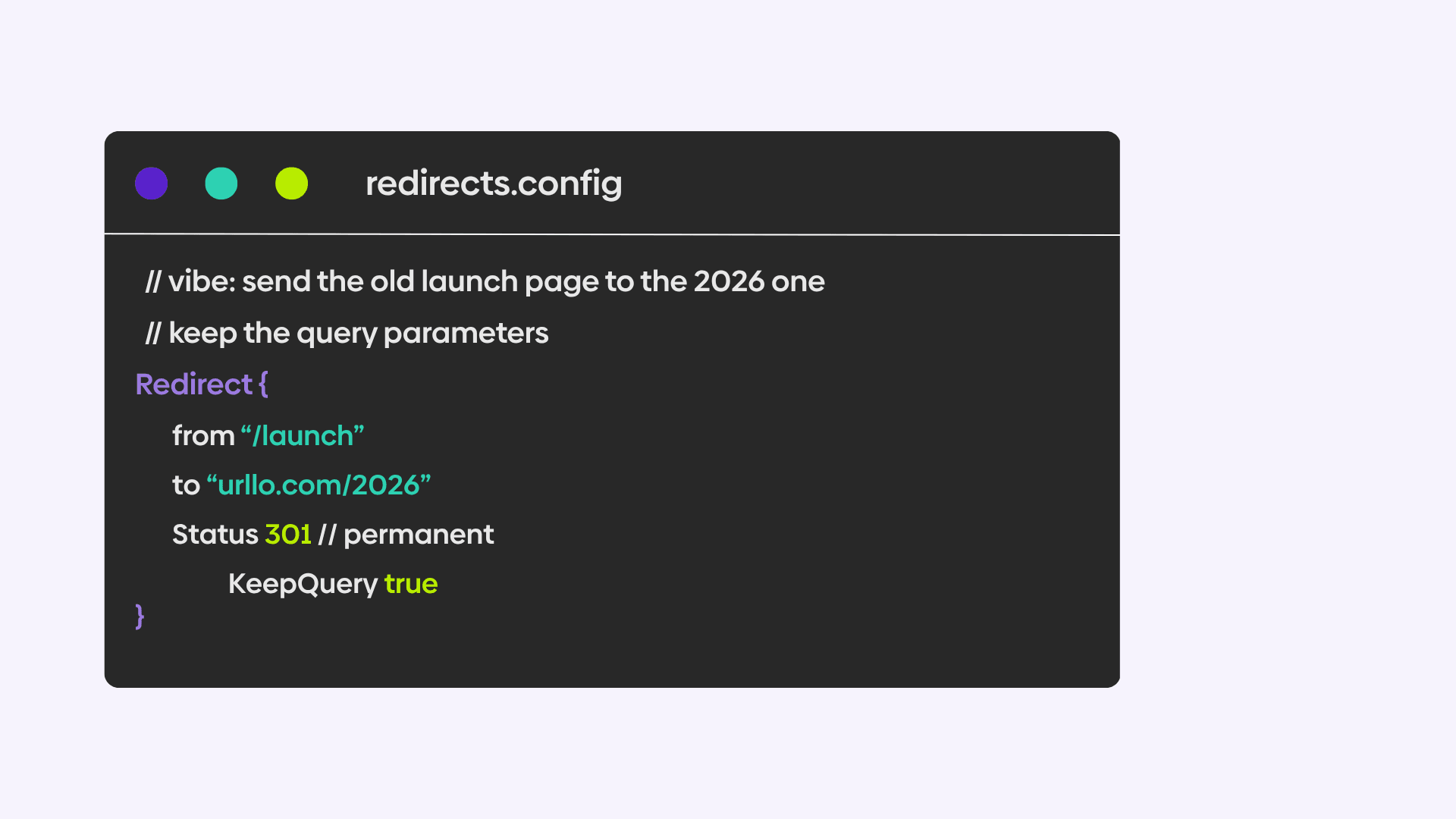
A typical AI-generated redirect tool will include a simple data store, often a JSON file or lightweight database. It will expose a basic route or API endpoint. You enter a long URL, get a short slug and redirect requests from one URL to another.
For a prototype, that can be enough.
You can click the link. You can see the redirect happen. You can show the workflow to your team. You can validate whether redirect-based link management fits the way you want to work.
That is real value.
The trouble starts when the tool leaves the happy path.
What happens when the destination URL is malformed? What happens when someone creates a redirect loop? What happens when a bad import affects hundreds or thousands of URLs?
A simple redirector is not built to answer those questions.
A production redirect service has to.
The gap between prototype and production
This is the part that often gets underestimated.
AI tools are good at generating what you ask for. They are much less reliable at protecting you from everything you forgot to ask for.
They may not ask whether the redirector needs to handle high traffic. They may not add destination validation. They may not include role-based access controls. They may not log who changed what. They may not capture analytics without slowing down the redirect response.
To get those things, you have to specify them.
But if you already know how to specify all of that, you are no longer asking for a simple redirector. You are defining redirect infrastructure.
That is the real distinction.
A vibe-coded tool can prove that a redirect is possible. A production service has to make redirects safe, observable and dependable at scale.
Here is what that difference looks like in practice.
| Feature area | Prototype redirector needs | Production-grade redirector needs |
|---|---|---|
| Core redirect logic | Basic source-to-destination URL mapping. Accepts a short slug or source URL and redirects users to the target URL. | Reliable redirect processing across many domains, websites and traffic patterns, with support for business-critical URLs. |
| Data storage | Simple data store such as a JSON file, spreadsheet or lightweight database. | Scalable, resilient data architecture designed for high read volume, safe updates and operational reliability. |
| User interface | Minimal form or API endpoint to create and test redirects. | Intuitive dashboard for creating, editing, searching, organizing and managing redirects across teams. |
| API support | Basic endpoint for creating or resolving redirects. | Secure management API for bulk creation, updates, workflow automation and integration with internal systems. |
| Security controls | Limited or no security beyond basic application defaults. | HTTPS enforcement, secure defaults, authenticated rule management and validation of redirect inputs. |
| SSL/TLS handling | Usually manual or out of scope. | Automated SSL/TLS management so domains and redirects stay secure without manual certificate work. |
| Lost traffic visibility | Usually none. Broken links may fail silently. | Lost traffic reporting to help teams find 404s, missed redirects and uncaptured migration traffic. |
| Performance | Works under light testing or low internal usage. | Low-latency redirect resolution designed for high traffic, spikes and customer-facing journeys. |
| Infrastructure | Single server, basic hosting or local deployment. | Reliable infrastructure with health checks, redundancy, failover logic and rollback-safe deployment practices. |
| DDoS resilience | Typically not considered. | Protection for business-critical URLs against DDoS attacks and traffic surges. |
| Analytics | Optional or basic click counting, if prompted. | Structured analytics for redirect volume, referrers, devices, geography, campaign performance and trend reporting. |
| Access controls | Often no authentication or a single admin user. | Authentication, role-based permissions and team-level governance over who can create, edit or delete redirects. |
| Audit trails | Usually none. | Audit logs showing who changed what, when and why, especially for incident response and compliance. |
| Bulk imports | Manual entry or basic CSV upload, if included. | Bulk migration tools with validation, testing, import support and recovery paths for large redirect sets. |
| Rule flexibility | Simple exact-match redirects. | Exact matches, path forwarding, query parameter forwarding, partial path matching, fallback logic and handling for case or trailing-slash differences. |
| Team workflow | Built for one person or a small controlled test. | Built for marketing, SEO, IT and WebOps teams working together with shared visibility and governance. |
| Best-fit use case | Learning, prototyping, validating an idea, internal testing or one-off low-risk campaigns. | Customer-facing websites, rebrands, migrations, domain consolidations, large campaigns and business-critical redirect infrastructure. |
| Risk tolerance | Acceptable when URLs are not business-critical and are low-stakes. | Designed for situations where downtime, latency, broken links, SEO loss or security gaps create real business risk. |
Where vibe coding falls short for redirects
URL redirect services look simple, but they carry real operational weight. Here is where the gaps typically appear.
Security and input validation
A vibe-coded redirector is easy to build in a way that quietly opens a hole. If it takes its destination from a URL parameter or an unauthenticated form, it can become an open redirect that forwards your visitors to a phishing page under your own domain's name.
A production service avoids that by design: destinations are set by authenticated users, not accepted from arbitrary request-time input. That shifts the real risk to the account itself, which is why HTTPS enforcement, access controls, SSO, MFA and audit logging matter for production redirects.
That’s just at the redirect level; keep in mind that popular vibe coding tools such as Lovable have had security issues before, which exposed data from public projects to anyone with an account. Another security issue with vibe coding is deployment without full understanding. Users may ship applications without grasping the permissions, authentication and data exposure decisions behind them, which leads to vulnerabilities.
Error handling
What happens when a slug does not exist? A production service returns a meaningful error response, logs the miss and potentially alerts on unusual 404 patterns that might indicate a broken campaign link or a crawl anomaly.
Broken redirects affect users and can quietly damage SEO performance without anyone noticing, eroding link equity and wasting crawl budget on pages that no longer exist. A vibe-coded version often returns a generic error or crashes the request entirely. Poor error handling means broken links fail silently without logging or alerting your team.
Performance under load
A basic redirector running on a single server can work perfectly during testing.
That does not mean it’s ready for traffic.
Redirect latency matters because every redirect adds time to the user journey. A slow redirect chain can affect user experience, campaign performance and SEO outcomes. At higher volumes, a simple database lookup on a single origin can become a bottleneck.
Reliable redirect infrastructure needs fast resolution, caching, global delivery and a system designed to keep redirects moving even when traffic spikes.
This is the scale a managed redirect layer is built for. urllo processes more than 25 billion requests each year, delivering redirects across a global network rather than sending every request back to a single application server.
For customer-facing websites and campaigns, speed affects how customers see your brand.
Analytics and observability
You need to know what is happening with your redirects. Click data, referrer information, device breakdowns and geographic distribution help teams understand how links perform. Lost-traffic reporting can also reveal missed migration paths and URLs that are still receiving visits but no longer have a valid destination.
A production platform should combine those analytics with governance: shared visibility, controlled access and an audit trail showing how redirect rules change over time. urllo treats these capabilities as part of the redirect infrastructure rather than as reporting added around the edges.
Access controls and audit trails
Who can create, edit or delete redirects? A production service tracks who created which redirects, when they changed and who has permission to modify them. This matters for teams, for compliance and for recovering from accidental deletions. A vibe-coded prototype typically has no auth layer at all.
What production redirect management needs
A reliable redirect service needs more than routing logic.
It needs the infrastructure, controls and workflows that make redirects safe to manage over time.
Reliable infrastructure
Reliability means your redirect service needs to stay online even when your primary database has a hiccup or a deployment goes sideways.
This requires health checks, failover logic and deployment pipelines that allow rollbacks without downtime. A single-server setup with no redundancy will eventually fail at the worst possible moment. Production infrastructure is designed around that assumption.
Edge delivery for low page load speed
Edge delivery resolves redirect requests from infrastructure close to the visitor rather than sending every request to a single origin. A production service may use distributed points of presence, caching or other globally deployed routing infrastructure to reduce latency and avoid dependence on one application server.
For campaigns driving significant traffic, even small differences in latency can affect user experience and bounce rate. Vibe-coded solutions almost never include CDN integration or edge routing by default.
Structured analytics
Analytics means capturing redirect events in a way that is queryable, exportable and accurate. You want to know which links are driving traffic, where that traffic is coming from and whether your campaigns are working. This requires asynchronous event capture so analytics never block the redirect itself, a schema that supports the dimensions you care about and retention policies that comply with any applicable privacy regulations.
Bulk migration support
Redirect problems are rarely one-at-a-time problems.
During a rebrand, migration or domain consolidation, teams may need to import hundreds, thousands or even hundreds of thousands of redirects. A production system needs bulk tools, validation, testing and a way to recover if something goes wrong.
A spreadsheet upload is not enough on its own. Teams need confidence that large redirect changes will work before traffic depends on them.
Redirect management in practice
Berlitz needed to manage thousands of redirects across global website migrations. Its Head of Global SEO and Content Marketing described the process with EasyRedir, now urllo, as “extremely manageable.”
Proper access controls
Ensure proper access controls with authentication, role-based permissions and an audit log. Teams need to know who changed what and when. This becomes critical during incident response when you need to understand whether a redirect was accidentally modified or when you are onboarding new team members who should not have full administrative access.
When vibe coding a redirect tool makes sense
This is not a case against vibe coding.
It is a case for using it in the right place.
A vibe-coded redirector can be useful when you are validating an idea, building a low-risk internal tool or a one-off campaign tool. It gives you something fast, tangible and inexpensive to test.
You are validating an idea.
Before investing in a proper tool or service, you want to know whether redirect-based workflows fit your process. A vibe-coded prototype lets you test the concept with a small group without any commitment. You might discover the workflow does not suit your team or you might discover strong demand that justifies building or buying something robust. The prototype serves as a low-cost experiment with a clear decision point: if it gets traction, you graduate to something production-ready.
You need a one-off campaign tool.
If you are running a single campaign, controlling who sees the link and can accept that the service might go offline, a vibe-coded redirector is a reasonable choice. The risk tolerance is explicit and the stakes are bounded. You know the tool is ephemeral. You have a clear end date. The acceptable failure mode is that the link stops working, which is fine for an internal test but would be unacceptable for a customer-facing campaign at scale.
You are building for a controlled environment.
Internal tools used by a handful of known users, behind a VPN or on a private network, have a much lower bar than public-facing services. If your team is using a redirect service to manage internal documentation links or route staging environment traffic, a vibe-coded solution may be entirely sufficient. The moment that tool becomes customer-facing or handles traffic at any meaningful scale, you have outgrown it.
Common redirect failures a prototype may miss
| Failure | What it looks like | Why it matters |
|---|---|---|
| Redirect loop | /old-page redirects to /new-page, which redirects back to /old-page. |
Users and crawlers get stuck. |
| Redirect chain | Page A redirects to B, then C, then D. | Slower load times and weaker SEO outcomes. |
| Open redirect | Your domain redirects users to an untrusted external site. | Phishing and brand trust risk. |
| Missing 404 handling | Invalid slugs fail silently. | Broken campaigns are harder to detect. |
| Rule conflict | A wildcard rule overrides a specific page rule. | Important URLs route to the wrong place. |
| No rollback | A bad import affects hundreds of URLs. | Recovery becomes manual and slow. |
The better path
Vibe coding is a good way to learn.
It can help you understand that redirects involve status codes, routing, data storage, validation, link management and user journeys. That knowledge is valuable. It can make you a better buyer, builder or operator of redirect infrastructure.
But production redirect management is not just about sending one URL to another.
It is about protecting every connection your teams depend on.
That means security controls, fast global delivery, SSL/TLS handling, access management, audit trails, analytics, fallback logic and support for the messy reality of websites and domains at scale.
A prototype can show you what is possible.
When those redirects become customer-facing or business-critical, a managed platform removes the need to build and operate the surrounding infrastructure yourself. urllo combines automatic HTTPS, low-latency global delivery, redirect analytics, access controls and governance in one managed redirect layer.
It has supported redirects since 2014 and now handles more than 25 billion requests annually for organizations ranging from small teams to global enterprises.
Conclusion
You can vibe code a URL redirector. For a prototype, that may be exactly the right move.
But customer-facing redirects deserve more than a working demo. They need infrastructure built for scale, security, visibility and change.
The smarter path is to use the prototype for what it does best: learning, testing and clarifying what your team needs. Then move to a redirect service designed for the hard parts from the start.
Organizations including IKEA, UNICEF and Crunchyroll trust urllo to support the domains and redirects their users depend on.
Because redirects are not just technical plumbing.
They are the connections between your users, your campaigns, your websites and your brand.
When one breaks during a migration or a paid campaign, the lost traffic, the broken customer journey and the wasted ad spend are the real cost.
Frequently asked questions about vibe coding URL redirect services
Can you vibe code a working URL redirect service?
Yes, you can vibe code a working URL redirect service in the sense that it will accept requests and return redirect responses. The result handles the basic happy path well and is useful for prototyping. What it will not include without careful, detailed prompting are security controls, error handling, analytics capture, access management and the infrastructure needed to run reliably at scale.
What is vibe coding and how does it work for web tools?
Vibe coding is a development approach where you describe what you want in natural language and an AI model generates the code. Tools like GitHub Copilot, ChatGPT and Claude are commonly used for this.
For web tools like a URL redirector, you describe the functionality you need and the AI produces a working implementation. The quality of the output depends on how precisely you can describe the requirements, including edge cases and failure modes.
When is vibe coding a redirect tool a good idea?
Vibe coding can be a good idea when you are testing a concept, building a short-lived internal tool or learning how redirects work.
It is less suitable when the redirects are customer-facing, business-critical, security-sensitive or expected to handle meaningful traffic.
What does a production-grade URL redirector actually need?
A production-grade URL redirector needs reliable infrastructure with failover, edge delivery for low page load speed and structured analytics that capture clicks without blocking redirect performance. It also needs custom domain support, role-based access controls and a full audit trail of changes. Each of these requirements represents a category of failure that a prototype will not handle on its own.
How is vibe coding different from traditional software development?
Traditional software development involves writing code manually with full awareness of architecture, security patterns, performance requirements and operational concerns. The developer is responsible for every decision.
Vibe coding delegates code generation to an AI and shifts the developer's role toward directing, reviewing and debugging. This makes it faster and more accessible, but it also means the output may not reliably account for requirements, edge cases or operational risks that were not clearly specified and reviewed. Security considerations, edge case handling and operational requirements are only present if you asked for them.
What are the biggest risks of using AI-generated code for redirects?
The biggest risks are open redirect vulnerabilities, missing validation, poor error handling, no audit trail, limited performance under load and no visibility into redirect traffic.
Those risks are manageable in a controlled prototype. They are much harder to accept in a production environment where users, search engines and internal teams depend on every redirect working correctly.
Why do redirects need analytics?
Redirect analytics help teams understand what is happening after a link is clicked. They can show which redirects are being used, where traffic is coming from, which links are broken and whether campaigns or migrations are performing as expected.
Without analytics, teams may not notice lost traffic, missed redirects or broken user journeys until they have already caused damage.

By Sarah Ellis
Director of Enterprise Accounts
Sarah is a passionate sales and management leader with over two decades of experience in the start-up, technology, real estate and music/advertising sectors. Sarah started her entrepreneurial journey years ago when she founded and ran her own bakery. Which is why she’s still the premier source of baked goods inside the urllo office.


.png&w=2560&q=88)



.png&w=2560&q=88)